....To Santiago

Wednesday, November 7, 2012

We are all pilgrims


On October 30th, late in the afternoon, we staggered up the Mount of Joy overlooking Santiago, filled with disappointment that all we could see were sprawling modern buildings with the great cathedral completely obscured from our gaze.  We had envisioned arriving at the crest and seeing the original medieval city in all its splendor, cathedral spires flashing like a beacon, laying invitingly before us in the valley.  Not the case.  Nonetheless, we wended our way down the final two kilometers of a thirty-two kilometer day through the suburban scree which jumbles around the outskirts of modern Santiago.

Finally, we found the great cathedral in view and we made our way immediately, not to the Pilgrim's Office to get our Compostelas, but directly to our new hostel quarters at the Seminario Mayor de Hospedaria, an arm's length from the cathedral.  This is a massive two-city-block building housing several hundred simple rooms for dead-tired pilgrims at reasonable cost.  It was a wonderful place to decompress and debrief with other pilgrims.  We collapsed in a heap of dirty clothes in our tiny cell, which, though it be small and spartan, had a private bathroom with a hot shower--bliss!

Stuart made himself at home immediately in pilgrim-style:


The next day, All Hallows Eve, we made our way to the Pilgrim's Office, and stood for the obligatory photo in front of the Cathedral:


With great joy we met up with our loosely affiliated camino family as they one-by-one entered the city through the square in front of the Seminario Mayor...What a great location with the Camino wending its way right past us so that we were privileged to witness every pilgrim arriving in the city for the first time, heading doggedly to the Pilgrim's Office!

We spent the next two days exploring Santiago and
meeting up with our camino friends for a farewell dinner.  Many of them were planning their walk to Finisterre or Muxia in the following days, but we had decided to forgo those final kilometers leading to the Atlantic Ocean in favor of returning home a few days early. Somehow we knew that we were done with our walking, and Hurricane Sandy hitting the East Coast of the U.S. made our return home more urgent since everyone we knew and loved was being affected by the storm.

"We are all pilgrims -- grateful for the harvest and yet longing for home."
                                                                        --Margaret Scott


Lastly, we attended the All Saint's Day Mass at  Santiago Cathedral, a very grand service full of processions with pilgrims flowing in and filling the aisles with their mochillas as they arrived, the Archbishop of Santiago presiding, and the famous butofumeiro which was swung through the transepts right above our heads.


On a journey filled with rituals--pilgrim Masses, leaving stones on pilgrim-built cairns and memorials along the Way, embracing the statue of St. James in the cathedral, the foot-preparation rituals for each day's walk--I think the rituals that touched me most deeply were the ones I shared with the hundreds of thousands of pilgrims who have come before me as well as those who will come after.  I am thinking of the most profound ritual of standing with pilgrims in the dark corner of the Cathedral at the Gate of Glory below the column depicting the Tree of Jesse, where atop St. James sits serenely holding a scroll, with each of us silently holding out our hand to "touch" the column in that place where the impression of a million pilgrims' hands has worn a one-inch deep impression of a human hand on the Tree of Jesse.  Pilgrims are no longer allowed to touch the column; it is surrounded by scaffolding to keep us at a distance, but every pilgrim stands near it, and instinctively holds out their hand in the air to line up with that impression as if to touch that place, that place of arrival.  It is, I think, a pilgrim ritual with great power; the sense of solidarity with so many other souls in marking the moment of the end of a pilgrimage is inexpressible in words.


Buen Camino!


Stuart and I walked 600 km of the total distance of 800 km from St. Jean Pied-de-Port, France  to Santiago, Spain.  We skipped a 200 km section in the Meseta region.  We are happy to report that we had a blister-free Camino!


For anyone interested in how we progressed daily, here is the data:


September 27    7.50 km   St. Jean Pied-de-Port, France  >>> Orrison Albergue, France
 
September 28   20.0 km   Orrison  >>>  Monastery at Roncevalles, Spain

September 29   21.0 km   Roncevalles   >>>  Zubiri, El Palo de Avellano Albergue

September 30   15.0 km     Zubiri  >>>  Pamplona (Villava) Trinidad de Arre Monastery

October 1        9.7 km      Pamplona   >>>  Cizur Menor, Albergue Roncal

October 2       18.0 km     Cizur Menor  >>>  Eunate Church, Eunate Albergue

October 3       23.0 km     Eunate  >>>  Villatuarte, Casa de Magica Albergue

October 4        4.5  km    Villatuarte  >>>  Estella,  San Miguel Albergue

October 5       21.0 km     Estella  >>>  Los Arcos, Casa de Austria II Albergue

October 6       19.5 km     Los Arcos  >>>  Viana,  Monastery (municipal) Albergue

October 7      21.5 km     Viana  >>> Logrono  >>>  Navarette, La Casa del Peregrino Albergue

October 8      16.5 km     Navarette  >>>  Najera, La Juderia Albergue

October 9      21.0 km     Najera  >>>  Santo Domingo de Calzada, Monastery (municipal) Albergue

October 10    17.9 km     Santo Domingo  >>> Villamayor del Rio (Burgos) El Camino eres Tu Alb.

October 11      5.0 km     Villamayor del Rio  >>>  Belorado

October 11      45 km      Belorado  >>>  Burgos (by bus),  Municipal Albergue

October 12    180 km      Burgos  >>>>  Leon (by bus), Monastery (municipal) Albergue

October 13    28.0 km     Leon  >>>  Villar de Mazarife,  Tio Pepe Albergue

October 14   15.5 km      Mazarife  >>> Hospital de Orbigo, Albergue Verde

October 15   18.0 km      Hospital de Orbigo  >>>  Astorga, Plaza Azur Hotel

October 18   22.0 km      Astorga  >>>  Rabanal, Confraternity of St. James Albergue

October 19   16.5 km      Rabanal  >>>  Acebo  (Monte Irago), La Trucha del Arco Iris casa rural

October 20   15.0 km      Acebo  >>>  Ponferrada,  Bierzo Plaza Hotel

October 21   21.0 km      Ponferrada  >>>  Villafranca del Bierzo, De La Piedra Albergue

October 22   19.5 km      Villafranca  >>>  Herrerias, Casa do Ferreiro Albergue

October 23   16.3 km      Herrerias  >>>  Alto de Poio (O'Cebreiro), Santa Maria Albergue

October 24   24.0 km      Alto de Poio  >>>  Samos, (monastic city) Hostal Victoria

October 25    15.6 km     Samos  >>>  Sarria, Escalinata Hostal

October 26    23.9 km      Sarria  >>>  Portomarin,  Posada del Camino Hostal

October 27    15.5 km      Portomarin  >>>  Ventas de Naron,  Albergue Turistico

October 28    27.5 km      Ventas de Naron  >>>  Melide, O Apalpador Albergue

October 29    26.0 km      Melide  >>>  Salcade, Pousade de Salcade  (municipal) Albergue

October 30   32.0 km       Salcade  >>>  Santiago, Seminario Mayor Hospederia (Hostal)


Tuesday, November 6, 2012

Video Clips


It is difficult to share the experience of a pilgrimage with others, so when I found this video, I thought I should post it here: it expresses so beautifully the Camino experience!


And this ancient pilgrim song:


Ultreïa!

Tous les matins nous prenons le chemin

tous les matins nous allons plus loin.

Jour après jour la route nous appelle

c'est la voix de Compostelle

Ultreia, ultreia
Et suseia
Deus adjuva nos!


Chemin de terre et chemin de foi,

voie millénaire de l'Europe,

la voie lactée de Charlemagne, ces le chemin de tous les jacquets.

Ultreia!...

Et tout là-bas au bout du continent,

messire Jacques nous attend

depuis toujours son sourire fixe

le soleil qui meurt au Finistère.

(letra y música: Jean Claude Bénazet)


Ultreïa!

Every morning we take the Camino,

Every morning we go farther,

Day after day the road calls us,

It’s the voice of Compostela!

Onward! Onward!
And upward!
God assist us!

Way of earth and way of faith,

Ancient road of Europe,

The Milky Way of Charlemagne,

It’s the Chemin of all the Santiago pilgrims!

Onward!...

And over there at the end of the continent,

Santiago waits for us,

His smile always fixed

On the sun that dies at Finisterre.


Saturday, October 27, 2012

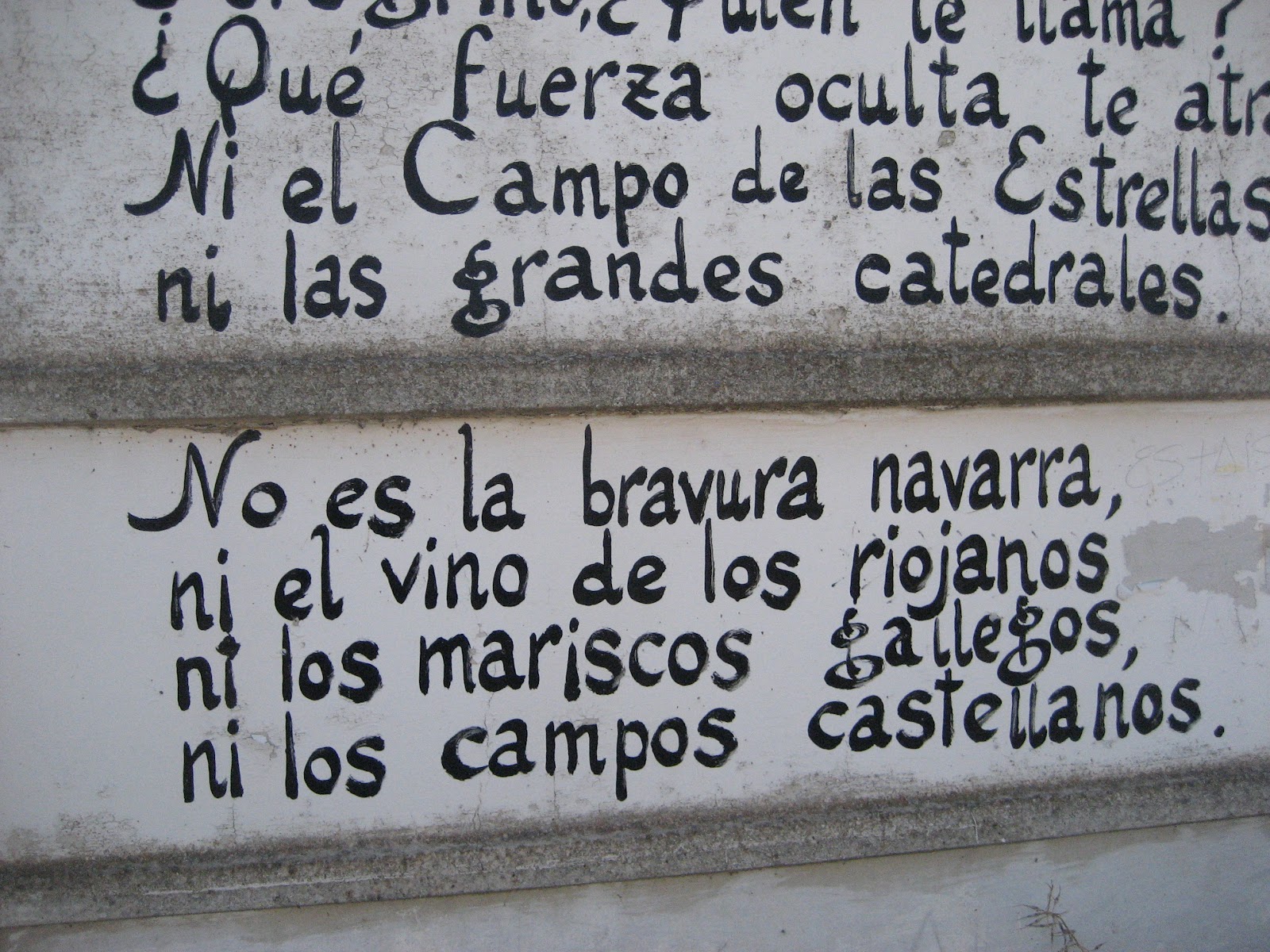
Pilgrim, Who Calls You?

This poem is written on a wall outside of Najera on the Camino Frances.
I have spent quite a lot of time at the end of my walks trying to
 translate it as gracefully as I can.  
I thank Roberto, Manuel, and Irene for their input 
over the course of a late afternoon in front of a hostel 
as they pored over this poem with me.  

Dust, mud, sun and rain
are the Camino de Santiago.
Thousands of pilgrims
and more than a thousand years.

Pilgrim, Who calls you?
What mysterious force draws you here?
Not the Field of Stars
nor the great cathedrals.


Not the bravado of Navarra,
nor the wine of Rioja
not the bounty of the seas of Gallego,
 nor the Castilian plateau.

Pilgrim, Who calls you?
What mysterioius force draws you here?
Not the folk of the Way
nor the ways of the country folk.
It is not the history and the culture, 
nor the cocky Calzada rooster
not the palace of Gaudi,
nor the Castle of Ponferrada.
All these things I see in passing,
and they are all a great joy,
but the voice that calls me
fills me with an even greater feeling.


The force that compels me,
the force that draws me here
I cannot explain:
Only the Most High knows!

Wednesday, October 24, 2012

Day 28: The Galician Portal

Walking through the mountainous regions of the Bierzo region and entering Galicia marks the final stage of our pilgrimage to the city of Santiago, which is now about 125 km away.  Climbing to the village of O´Cebreiro, scaling a mountain in a straight vertical climb to its summit at 1,500 meters, gave a great sense of accomplishment to every pilgrim who surfaced in the lovely town at the top.  At the summit, the westerly winds from the Atlantic are suddenly tangible, and the climate shifts into a maritime brew of breezy, wet seaborn air as we enter Galicia, the fourth and final region through which we will pass.


Two days earlier, we scaled Monte Irago where the Cruz de Ferro stands as a solemn monument for pilgrims who have left their momentos, carried from home or picked up along the Way, at its base for centuries.  The foundation of the soaring wood and iron cross is covered with an extraordinary pile of stones, tokens, messages, and a multitude of pilgrim prayers.  Stuart and I also left our tokens there.


Tonight, after following a grueling 24 km detour through what seemed like endless up and down switchbacks, mud and scree, we are in Samos, a grey-stoned monastic city perched in a Galician mountain valley, lost in a quiet murmur of waterfalls and mossy verdure.  The contrast with the sunny Meseta of just two weeks ago is reflected in what we now wear as we hike:  the rain poncho rarely comes off now as the weather in Galicia is wildly changeable from minute to minute with wind, rain and sun mixed up in this crazy patchwork climate.  We attended Vespers and Mass this evening in the monastery and a cheery priest sang a sweet blessing over the pilgrims in attendance. 

Having come this far along the Camino, many pilgrims we have met along the way are reappearing in these last days, some of whom we have not seen since Pamplona or Burgos.  They all co-mingle in  loose Camino families who travel together in bands.  Some of these pilgrims have shared with me their more personal reasons for being on the Camino and I have been deepened and humbled by their stories.  So now we travel together in twos and threes, sometimes talking, often silent, often fatigued, but eager to reach the end of our journey in Santiago.  Some of us will go on to Finisterre, but that is up in the air for most.  Our walk together, one way or another, is coming to an end.

Wednesday, October 17, 2012

Fuentes Espirituales

Camino Photos here


Astorga is still home today as Stuart is not strong enough to continue on just yet.  We don´t know if he got infected with bad water, food or other pilgrims, but gastroenteritis is a common ailment among pilgrims.  We will probably be very cautious about our water sources going forward because the feuentes in the villages and towns, refreshing as they seem to be, may be suspect.

But what about the spiritual founts that spring up on the Way?

A visit to Astorga Cathedral yesterday evening gave us a taste of local life as Mass was underway, with incense and a booming cantor, and dozens of seminarians in white albs seated at the front of the nave.  We could not enter but we took in the ambience of reverence, sitting in a sweet chapel dedicated to Mary, and finding a compelling statue of St. James, who stood fast with a world-weary, yet compasssionate gaze in his pilgrim garb of cape, shells, staff, gourd and bare feet.  In the Camino Pilgrim museum next door in the Gaudi Palacio, there were several such images of St. James, each one a contemplative masterpiece, and each one speaking to an aspect of the pilgrim soul.  At this point in our journey, we are more and more thirsty for such reassurances from Santiago that calm perserverance on the Way will bear fruit within our beings.

The outer landscape may be challenging for each of us, but it is more a reflection of the inner landscape, which is even more challenging and magnified as we steel ourselves for the hardships of the Path.
I found a poignant piece of French graffiti in a small hermit´s beehive hut--my rough translation:
The important thing is not to arrive;
The important thing is who arrives.

And there is also this anonymous poem from Navarre:


Walk
Alone with others 
Thou thyself thy rivals
Thou thyself finding thy companions
Thou thyself seeing thy enemies
Thou thyself making thy brothers

Walk
Thy head knows not where thy feet take thy heart

Walk
Pilgrim of the world

Walk

Thou art born for the Way


Walk
Thou hast an appointment
Where? With whom?

Walk
Thy steps thy words
The road, thy son

The fatigue, thy prayer
And thy silence, finally thy speech.

Walk
Thou art born for the way
That of pilgrimage
That other way leading to thyself
and thy quest

Walk
So that thou may find
at the shrine at the end of the world
Thy peace
Thy joy

Walk
Already, God walks with thee.


Tuesday, October 16, 2012

Rest in Astorga


I must first apologize for lack of communication from the Camino.  I can´t even check my email without intense frustration, and am giving up, so if you need to reach me, do so by comment here or message me on Facebook.  I am on free wifi for the first time in three weeks, which is allowing me the questionable luxury of catching up on things electronically.  I am finding myself cursing aloud in this hotel lobby, so I think it best to blog quietly, more befitting of my pilgrim status.

Today, we rest in Astorga before heading into the mountains for the next few days, as we enter the final 300 km of our pilgrimage to Santiago.  We have walked over 300 km to date, so are taking a much needed respite from the albergues at a hotel here in Astorga with hot baths!!!!  We are both exhausted from weather exposure, the weather having taken a decided turn towards the autumnal, with chill and rain and wind.
Stuart fell ill two days ago, so we limped into Astorga yesterday to collapse.

Astorga is our last chance to kit ourselves out before heading into the mountains of the Maragatos region:
I caved in and purchased gloves since the use of socks on our hands is becoming inadequate against the cold winds.  The wind was blowing so strongly from the mountains ahead two days ago that we were forced to turn back to Hospital de Orbigos in the foot hills where we stayed in a hippie-communal albergue with a vegetarian meal, rousing Spanish song on guitars, and some yoga to boot!  It was a center of Buddhist peace, and the hospitaleros there were fresh-faced and full of what I can only term camino caritas.

The Spaniards like their pork dishes, much to the dismay of any veggie-inclined pilgrim.  I hate to say it, but Spanish cuisine is a hardship for me, as there is only variation in the styles of pork available:  each region has specialities in how it cuts and cures its pork, and so the variety of pork dishes is absolutely bewildering!  Even more bewildering is the fact that we have not seen one pig farm, but only multitudes of cattle, sheep, chickens and dogs and feral cats.  The pigs must be in the south of Spain with the orange groves.  The cuisine for the peregrinos menu is predominantly pork, potatoes, eggs, cheese, bread and tomatoes--basically the warm reds, oranges and yellows of the Spanish flag.  In all fairness, though, the seafood is also wonderful in the larger towns.  As we near the Atlantic,  we are now entering ¨pulpo¨ territory, the specialty of the region which I am greatly anticipating!  I don´t think I will ever tire of the variety of octopus served here!  There are pulpo-terias in Galicia!  I can´t wait!

Have I mentioned the vinto tinto?  The peregrino menu may be humble, but it usually comes with a bottle of lovely red wine, which here runs as cheaply and freely as water from the village fuentes.  It is very good for restoring the muscles and is very low in alcohol content,so pilgrims live on it.  In the middle ages, when the water was questionable in every village (til the 1980's, actually!), the only thing pilgrims drank was vino tinto!
The vino tinto is young wine imbibed at every meal, and the vineyards in the Rioja region are resplendent with ripe grapes--we have walked through miles and miles of vineyards and curious earthen bodegas built on the outskirts of every hamlet and town.  At first, we thought they were low-income housing for the very poor, who were squatting on the outskirts, as the bodegas look like they might be inhabited by hobbits!  Silly, naive Americanos!
Today, we will visit the Camino Pilgrim museum here in Astorga inside the Gaudi Palacio.  The history of the various camino routes is fascinating and complex with the interplay of ancient tribal, feudal, and religious fealties forging the identities of these regions.  The Camino Frances, I am learning, developed as the northern front-line border of Christendom, forging a path of commerce, feudal alliances and religious infrastructure, with heavy and equal investment from both the kingdoms of France and Spain (Castile, Navarra, Aragon) creating a great display of fortified towns and cathedrals which were hastily built in the 12th century to fend off the Moorish expansion from the south. 

In a couple of days, we will reach the Cruz de Ferro, a pilgrim landmark on the peak of Monte Irago...
I will report in as soon as the bandwidth and the skies clear...